
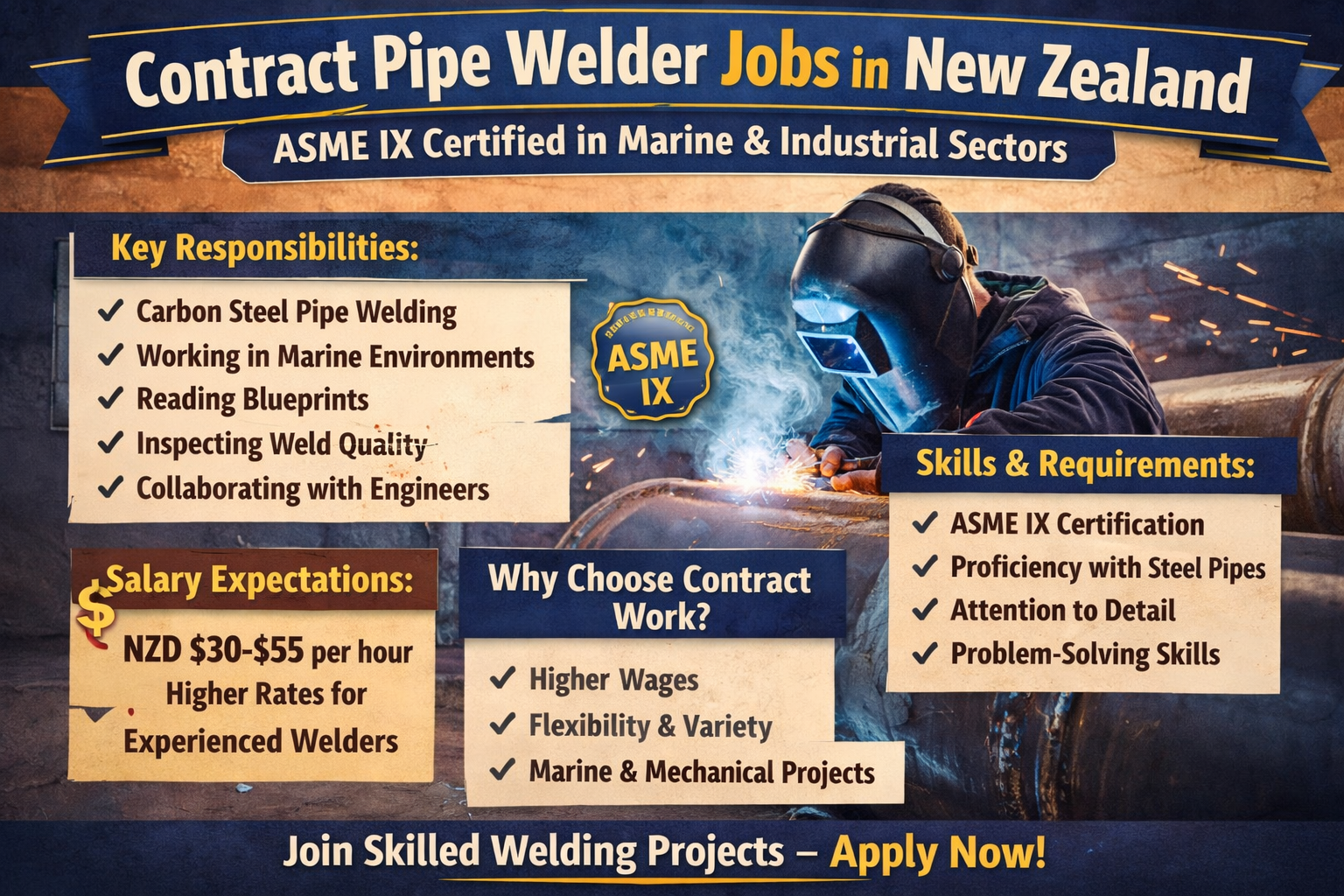
The demand for ASME IX Certified Pipe Welders continues to grow across industrial sectors in New Zealand. Large infrastructure projects, marine engineering operations, and mechanical piping installations require welders with strong technical skills and internationally recognized certification.
In cities such as Auckland, marine engineering companies rely on professional welders who handle carbon steel pipe welding, industrial piping systems, and high-spec mechanical installations. Skilled workers who hold ASME IX certification play a key role in maintaining safety standards and ensuring structural reliability in complex projects.
This guide explains the responsibilities, required skills, certification requirements, salary expectations, and career opportunities for Contract Pipe Welders in New Zealand.
Also Check
- Contract Pipe Welder Jobs in New Zealand
- Dairy Farm Hand Jobs In Australia 2026
- Farm Workers Supervisor Job In Canada 2026
- Truck Driver Job in Upper Hammonds Plains, Nova Scotia, Canada 2026
- Poultry Farm Worker Job in Puslinch, Ontario, Canada 2026
Understanding the Role of an ASME IX Certified Pipe Welder
A Contract Pipe Welder performs specialized welding tasks involving carbon steel pipes and industrial piping systems. These systems transport fluids, gases, and mechanical components across ships, factories, and large infrastructure facilities.
Projects in the marine sector require welders who understand pressure piping standards, structural welding techniques, and safety procedures.
An ASME IX certified welder follows strict welding codes defined by the American Society of Mechanical Engineers (ASME). These codes ensure weld strength, durability, and safety in high-pressure environments.
Contract welders often work on temporary project assignments while supporting large engineering teams.
Key Responsibilities of a Contract Pipe Welder
Professional welders perform multiple technical tasks throughout a project. Every weld must meet strict safety and engineering standards.
Carbon Steel Pipe Welding
The primary duty involves welding carbon steel piping systems used in marine vessels and industrial plants.
Typical welding tasks include:
- Preparing pipe joints before welding
- Performing TIG, MIG, or Stick welding depending on project specifications
- Maintaining proper heat control and weld penetration
- Completing multi-pass welds on thick piping systems
- Ensuring structural strength of pipe joints
Each weld must meet ASME IX code requirements to pass inspection.
Working in Marine Engineering Environments
Marine welding involves complex working conditions. Pipe welders often perform tasks inside shipyards, engine rooms, and offshore mechanical systems.
Responsibilities include:
- Installing piping systems on vessels
- Repairing marine mechanical components
- Welding pipelines used for fuel, cooling, and hydraulic systems
- Following strict marine safety regulations
Worksites require strong awareness of safety due to confined spaces and heavy equipment operations.
Reading Blueprints and Technical Drawings
Industrial welding projects depend on accurate interpretation of engineering documents.
Pipe welders must read:
- Mechanical piping diagrams
- Welding procedure specifications
- Technical blueprints
- Material specifications
This knowledge ensures correct pipe alignment, weld size, and structural strength.
Inspection and Quality Control
After welding tasks finish, workers inspect welds to verify compliance with engineering standards.
Inspection procedures include:
- Visual weld inspection
- Checking weld penetration and alignment
- Identifying cracks or defects
- Ensuring welds meet ASME IX specifications
Quality control remains critical in marine and industrial environments.
Collaboration with Engineering Teams
Large projects require coordination between multiple specialists.
Pipe welders often work alongside:
- Mechanical engineers
- Fabricators
- Pipefitters
- Marine technicians
Strong teamwork ensures projects meet deadlines, safety targets, and production schedules.
ASME IX Certification Requirements
The ASME Boiler and Pressure Vessel Code Section IX sets international standards for welding procedures and qualifications.
This certification confirms that a welder can produce structurally sound welds for pressure piping systems.
To obtain ASME IX certification, welders must:
- Complete a recognized welding training program
- Pass a welding performance test
- Demonstrate correct welding techniques on test materials
- Meet inspection standards during testing
Employers require this certification for jobs involving pressure vessels, boilers, and industrial pipelines.
Skills Required for Pipe Welding Jobs
Successful pipe welders combine technical expertise with strong work discipline.
Advanced Welding Skills
Professional welders must understand:
- TIG welding
- Stick welding
- Pipe joint preparation
- Heat control techniques
- Multi-pass welding
These skills ensure weld strength and reliability.
Attention to Detail
A small defect in a pipe weld leads to structural failure. Welders inspect each joint carefully during and after welding.
Attention to detail protects workers, equipment, and industrial facilities.
Problem-Solving Ability
Industrial worksites present unexpected challenges such as:
- Misaligned pipe sections
- Equipment failure
- Difficult welding positions
Experienced welders identify solutions quickly while maintaining quality standards.
Safety Awareness
Pipe welding involves high temperatures, electrical equipment, and heavy machinery.
Workers follow strict safety practices such as:
- Wearing protective welding gear
- Maintaining proper ventilation
- Following confined-space procedures
- Inspecting equipment before use
Strong safety awareness prevents workplace accidents.
Salary Expectations for Pipe Welders in New Zealand
Pipe welders with recognized certification earn competitive wages.
Typical pay ranges include:
- Entry-level certified welders: NZD 30 to NZD 40 per hour
- Experienced pipe welders: NZD 40 to NZD 55 per hour
- Specialized marine welders: NZD 55 or higher depending on project complexity
Contract positions often offer higher hourly rates due to short-term project demands and specialized skill requirements.
Benefits of Contract Welding Jobs
Many welders choose contract roles due to flexibility and income potential.
Advantages include:
- Higher hourly wages
- Opportunities across multiple projects
- Exposure to advanced industrial systems
- Experience in marine and heavy engineering sectors
Contract workers often gain experience with large mechanical installations and infrastructure projects.
Career Opportunities for Certified Pipe Welders
Welders with strong experience expand into higher positions within the industrial sector.
Career progression includes:
- Pipe Welder
- Senior Welding Specialist
- Welding Inspector
- Welding Supervisor
- Mechanical Fabrication Manager
Some welders pursue additional certification in welding inspection, mechanical engineering, or fabrication management.
Working in the New Zealand Marine Industry
New Zealand maintains a strong maritime economy. Ports, shipyards, and marine engineering companies require skilled workers to maintain vessels and mechanical systems.
Cities such as Auckland remain major centers for marine engineering, ship repair, and industrial piping projects.
Pipe welders with ASME IX certification gain access to stable work opportunities in these sectors.
How to Apply for Pipe Welder Jobs
Employers normally request several documents during the application process.
Applicants prepare:
- Updated resume with welding experience
- ASME IX certification proof
- Details of previous industrial projects
- Availability for contract work
Some employers request additional information such as:
- Expected hourly rate
- Years of pipe welding experience
- Availability for immediate start
Professional welders who demonstrate precision, reliability, and strong teamwork often receive priority consideration.
Why Skilled Welders Remain in High Demand
Industrial development continues across infrastructure, energy, and marine engineering sectors.
Demand grows for workers who perform precision welding on critical systems.
Certified welders help industries maintain safe pipelines, pressure vessels, and marine equipment.
Workers with advanced welding knowledge secure stable careers in global engineering industries.
Disclaimer
This article provides general information about Contract Pipe Welder jobs and ASME IX certification requirements. Salary ranges, job responsibilities, and employment conditions differ depending on the employer, project scope, and regional labor regulations. Readers should verify job details directly with employers or recruitment agencies before applying. Personal financial details such as bank accounts or credit card information should never be shared during job applications unless dealing with verified and trusted employers.